Position Playbooks
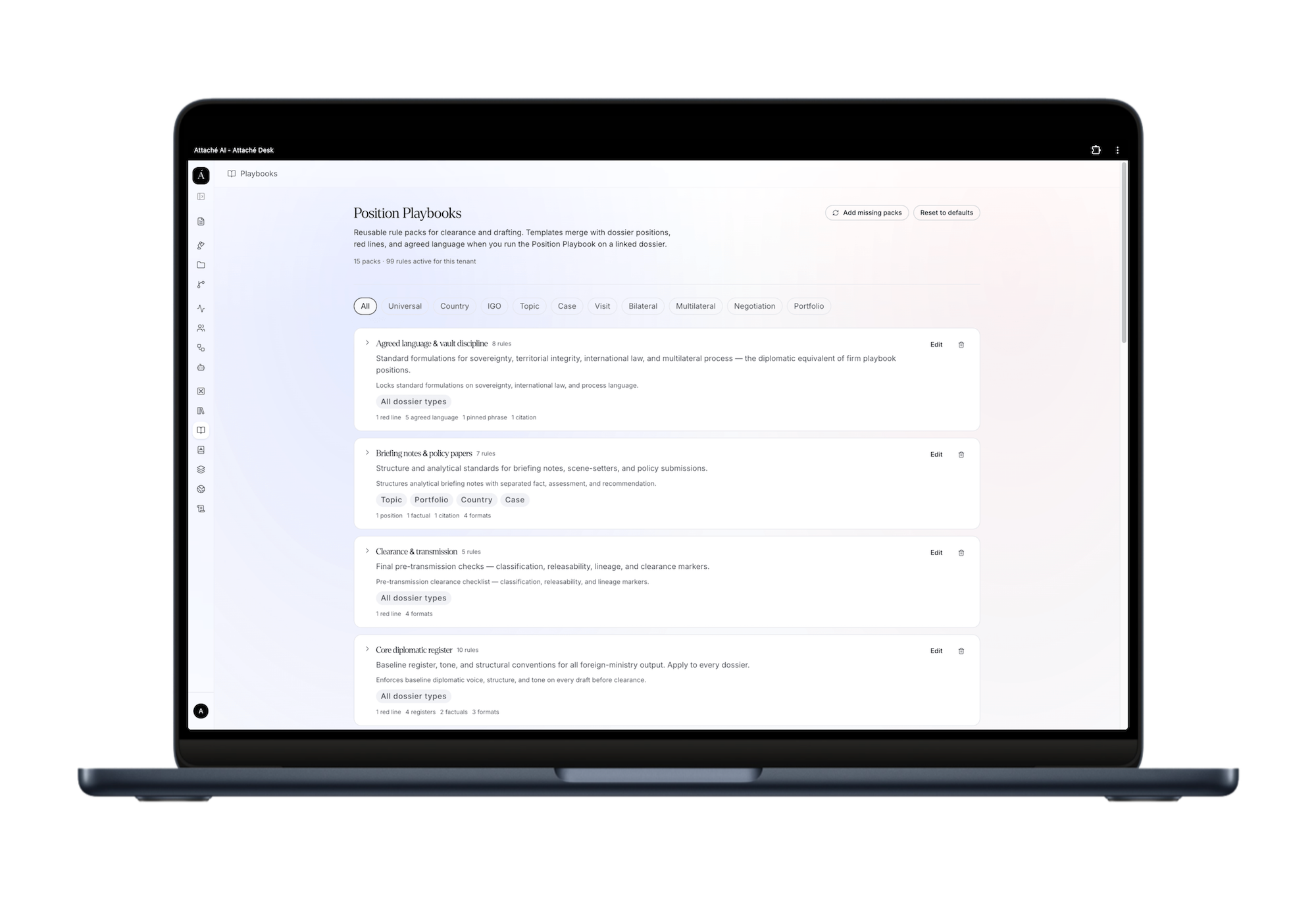
Reusable rule packs that turn institutional policy, red lines, and preferred formulations into checks the editor applies at every draft.

How it works
A Position Playbook converts what a ministry already knows - register conventions, national red lines, clearance steps, preferred formulations - into reusable drafting controls. When a playbook runs on a linked dossier, its rules merge with that dossier's positions, red lines, and agreed language, and findings surface in the editor rail for inline review with one-click fixes.
Playbooks preserve institutional memory when officers rotate. The knowledge that lives in a senior desk officer's head - "we never use that formulation," "always lead with the UN Charter citation before the bilateral argument" - becomes a check the platform can apply on every draft, for every officer. New workspaces load a starter library of 15 packs covering the core of diplomatic drafting. Every rule is editable; tenants can add packs, prune them, or reset to defaults.
How playbooks apply
Universal packs apply to every dossier unless the officer selects specific packs on the dossier's Playbook tab.
Type-specific packs auto-apply when the dossier type matches — across Country, IGO, Topic, Case, Visit, Bilateral, Multilateral, Negotiation, and Portfolio dossier types.
Run from anywhere: a dossier page, the document editor, or Review mode in the composer with Position Playbook enabled.
Findings as cards. Results appear in the editor rail as categorised cards with one-click Fix, so the officer reviews and accepts changes in context rather than re-reading the whole draft. Findings carry their rule type and severity so the officer knows immediately whether a finding needs policy sign-off or can be resolved editorially.
Eight rule types
Each pack is a set of typed rules. The type tells the officer what kind of check fired.
Position - Alignment with the dossier's stated policy position.
Red line - Hard constraints that must not be crossed.
Agreed language - Use of negotiated formulations from the Vault.
Pinned phrase - Specific wording the desk has fixed for this file.
Register - Diplomatic voice, tone, and structure.
Factual - Claims that need verification against sources.
Citation - Sourcing and reference discipline.
Format - Instrument-specific structure (cable, note verbale, talking points).
Findings carry one of two severities. Red indicates a hard constraint that usually requires policy or legal sign-off to override. Amber indicates a strong convention flagged for the officer's judgment.
The 15 starter packs
Core diplomatic register Baseline diplomatic voice, structure, and tone on every draft before clearance. Run before sending any cable, note, or briefing to principals. Register errors are the fastest way to lose credibility across the table - this catches colloquial language, emotive framing, and structural sloppiness senior counterparts notice immediately.
How do I get started?Locks standard formulations on sovereignty, international law, and process language. Use on conflict files, legal characterisations, humanitarian access, and any text citing the UN Charter. A single improvised phrase on territorial integrity can contradict years of agreed language and hand the counterpart a point of leverage.
Talking points (oral)Shapes ministerial and delegation talking points for live delivery - brevity, hierarchy, if-asked blocks. Written prose that reads well on paper often fails in the room. This enforces speakable bullets and authorised lines for sensitive Q&A.
What services do you offer?Structures analytical briefing with separated fact, assessment, and recommendation sections. Enforces the executive summary → background → assessment → recommendation ladder so principals get actionable advice, not undifferentiated background.
How do I get started?Formal instrument conventions - salutation, specific ask, legal basis. Démarches are archival records; vague asks or escalatory rhetoric create legal and political exposure. Cite treaty or Vienna Convention basis for operative paragraphs.
What makes you different?Bloc discipline, resolution citations, and procedural accuracy for UN, OSCE, EU, and IGO forums. National freelancing in bloc text breaks consensus; wrong procedural references get corrected on the floor.
Negotiation and treatyWe offer a range of solutions designed to meet your needs—whether you're just getting started or scaling something bigger. Everything is tailored to help you move forward with clarity and confidence.
Press and media linesGetting started is simple. Reach out through our contact form or schedule a call—we’ll walk you through the next steps and answer any questions along the way.
Human rights and valuesHuman rights démarches framed in universal standards with proportional severity. Framing errors - cultural superiority, false equivalence - undermine the goal. Match language tier to policy intent: monitor → raise → démarche → sanction.
Sanctions and restrictive measuresLegal basis, designation discipline, and humanitarian carve-out language. Premature designation leaks and missing carve-outs create compliance and humanitarian problems. Lead with the regulation or UNSC resolution citation.
Reporting cablesChancery reporting structure - summary lead, source protection, action request. Capital triages on the first three sentences; source exposure in cables is a career-ending error. End with an explicit action request.
EU Council coordination
EU coordination lines, silence-procedure references, and EEAS conventions. National nuance in EU text triggers reopening; flag national reservations in comment, not in the shared draft.
Crisis and consular commsCrisis and consular messaging - accuracy and compassion without speculation, coordinated with posts. Speculation about casualties or responsibility inflames crises and creates legal liability.
Summit and high-level visitsSummit and high-level-visit choreography - outcomes documents, gift policy, joint-statement structure. Visit outcomes are negotiated line by line; align talking points, joint statement, and press lines before the first bilateral.
Clearance and transmissionPre-transmission checklist - classification, releasability, and lineage markers. Over-classification blocks sharing; under-classification is a security incident. Run after the substance playbook and before marking a draft cleared.
Frequently asked questions
Not sure where to start? Reach out with any questions, or if you're ready to dive right in, schedule a free consultation today.
-
Yes. Every pack is editable. Tenants can add rules, edit existing ones, remove rules that don't apply to their mission's position, or reset a pack to the default starter version.
-
Playbooks are active during drafting and review — they check position alignment, red lines, and format conventions as the officer works. Protocol Score is a structured pre-clearance run across six formal axes on a completed draft. Playbooks shape the draft; Protocol Score evaluates it.
-
Playbooks are your mission's position rules, red lines, and drafting conventions. The Agreed Language Vault is the shared corpus of treaty, communiqué, and negotiated text that must be used verbatim. Both run checks; they draw from different sources. A Playbook rule might say "always cite the UN Charter before the bilateral argument"; the Vault supplies the exact Charter text that should appear.
-
A red finding means a hard constraint may have been crossed - typically a national red line or a legal formulation that cannot be improvised. The officer sees the finding in the rail with the specific passage highlighted. Fix applies a targeted AI rewrite; the officer can also edit manually. Ignoring a red finding is recorded in the audit log with a timestamp.
-
Yes. Playbooks are tenant-level assets. Any officer with editing permissions can update the packs, and the changes apply to all users in the account. This is how institutional knowledge is maintained when officers rotate.