Source Registry
Curated, tier-labelled sources for grounded diplomatic drafting - so an officer always knows whether a claim rests on agreed UN text, a foreign ministry statement, or open-source analysis.

How it works
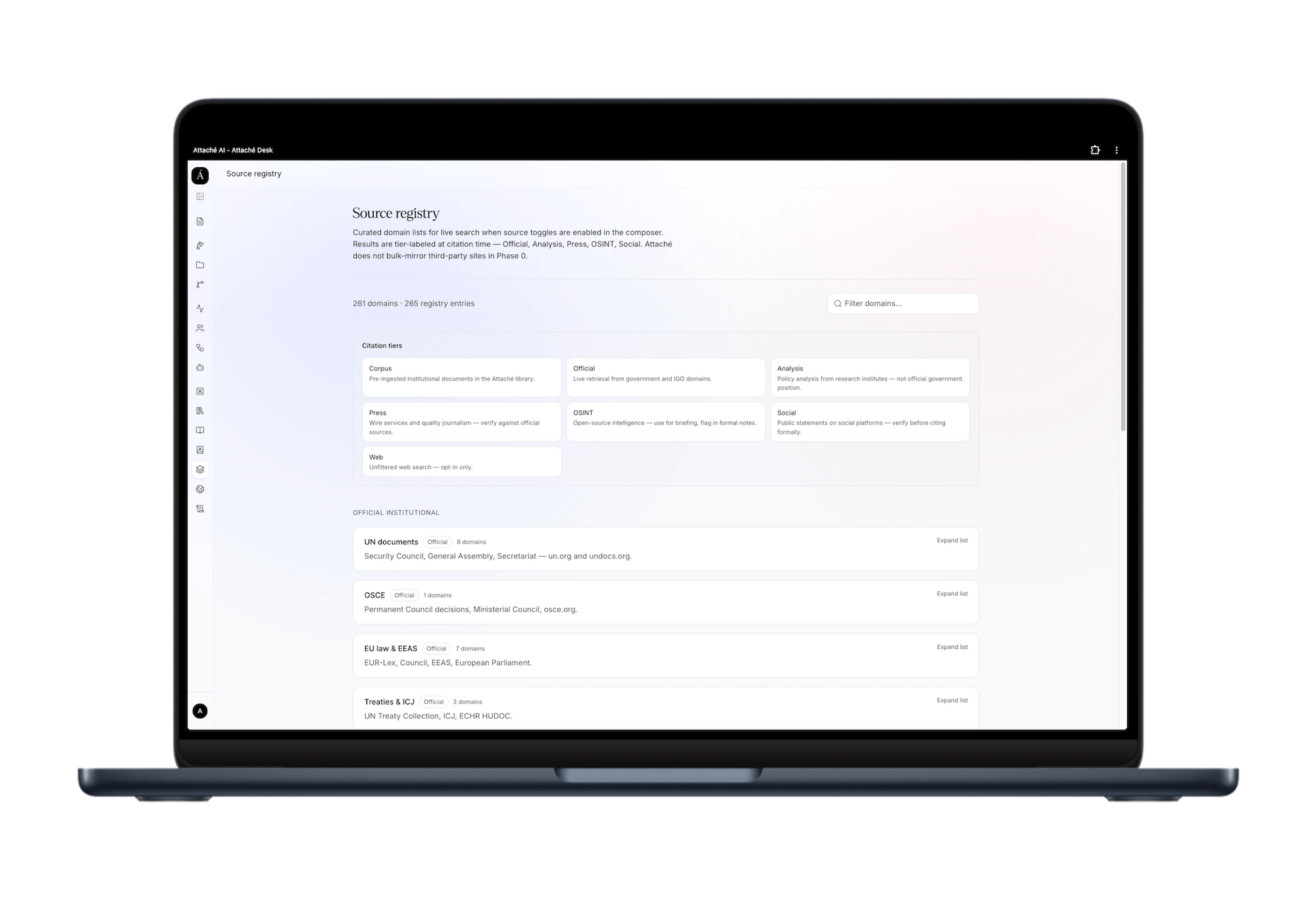
Attaché does not draft from an open prompt and hope. When live source toggles are enabled in the composer, retrieval is restricted to a curated registry of institutional, official, analytical, and open-source domains. Every result is labelled with its tier at citation time, so a desk officer reading a draft knows immediately whether a claim rests on an agreed UN text, a foreign-ministry statement, a think-tank assessment, or an open-source report. Pre-ingested authoritative corpus material always ranks above live retrieval.
The registry is organised into three groups of toggles. Defaults are tuned for serious institutional work: official corpora and foreign ministries on; press, OSINT, social, and broad web off until the officer opts in.
Analysis & intelligence
Opt-in tiers, labelled distinctly so analysis is never blended with official position.
Think tanks — CFR, Chatham House, IISS, RAND, SWP, ECFR. Analysis tier, not official. Off by default.
Trusted press — Reuters, AFP, FT, Politico.eu. Verify against official sources. Off by default.
OSINT — OpenSanctions, OFAC, ACLED, Bellingcat. Briefing use; link-only, no bulk storage. Off by default.
Social statements — public statements on X from official accounts. Off by default.
Broad web — unfiltered web search. Opt-in only.
Official institutional
Higher-trust retrieval targets. On by default unless noted.
UN documents — Security Council, General Assembly, Secretariat (un.org, undocs.org). On by default.
OSCE — Permanent Council decisions, Ministerial Council (osce.org). On by default.
EU law & EEAS — EUR-Lex, Council, EEAS, European Parliament. On by default.
Treaties & ICJ — UN Treaty Collection, ICJ, ECHR HUDOC. On by default.
NATO — summit communiqués and official texts (nato.int). On by default.
Council of Europe — CoE conventions, PACE (coe.int). Off by default.
G7 / G20 / multilateral — summit communiqués, IMF, World Bank, OECD, ASEAN, AU. Off by default.
Foreign ministries worldwide — official MFA domains for 140+ states; live statements only. On by default.
Law enforcement & security — Interpol, FBI, Europol, UNODC public releases. Off by default.
Your workspace
Local dossier — uploads and pinned language for the active dossier. On by default.
My library — your saved materials across dossiers. On by default.
The citation tiers
Every cited source resolves to one of seven tiers, ranked by trust. The ranking is what lets a reviewer triage a draft at a glance.
Corpus
Authoritative pre-ingested institutional documents in the Attaché library.
Analysis
Think-tank policy analysis - not an official government position.
OSINT
Open-source intelligence - use for briefing, flag in formal notes.
Official
Live retrieval from government and IGO domains.
Press
Wire services and quality journalism - verify against official sources.
Social & Web
Public statements on social platforms - verify before citing formally and unfiltered web search.
Classification overrides
Source selection is not just a UI preference - classification tightens it automatically, enforced at the API and database layers:
Live public research is disabled and retrieval stays inside official corpora and your workspace. The officer cannot accidentally pull a confidential draft against the open web.
How it behaves
Official sources rank first. Corpus and official-live tiers outrank analysis, press, OSINT, and social in retrieval and citation.
Workspace control. Source preferences narrow by dossier, region, and task, and intersect with the active region's allowlist.
No bulk-mirroring. Attaché does not mirror third-party sites. The registry is a curated list of where live search is permitted to look, with links resolved at read time.
Auditable. Source retrieval is recorded, so an institution can review how a document was grounded.
Think Tank Pulse
A policy-analysis radar surfaces relevant think-tank headlines in the Morning Brief, cached for 48 hours, so officers see the analytical conversation without leaving the workspace — clearly held at the Analysis tier, never mixed with official position.
Common questions
Does enabling a source send my draft to it? No. Toggles govern which curated domains live search may query for grounding; your draft content is not posted to those sites.
Can we use it air-gapped from the open web? Yes — run on official corpora and your workspace only, which is also the enforced behaviour for confidential work.
Who decides what's authoritative? The tier model. Corpus and official-government/IGO sources are treated as higher trust; analysis, press, OSINT, and social are labelled, not blended.

See how cited drafting works
7 citation tiers · 140+ foreign-ministry domains · official-first ranking.